
Court Marriage in Pakistan – Legal Nikah, Procedure & Registration
Confidential Court Marriage Services With Legal & Shariah Documentation
Nikah House assists legally eligible and consenting couples with Court Marriage in Pakistan, including legal guidance, Nikah solemnisation, Nikah Nama, documentation and marriage registration.
A Court Marriage in Pakistan is not a different form of Muslim marriage merely because lawyers or legal documentation are involved. For Muslim couples, the underlying marriage remains a Nikah, which must satisfy the applicable requirements of Muslim law and be properly registered under Pakistani law.
Our legal team assists couples in Karachi, Islamabad, Rawalpindi and Lahore, including couples facing family opposition and Pakistanis residing abroad.
A Nikah Nama is one of the most important legal documents created during a Muslim marriage in Pakistan.
It is not merely a ceremonial form to be signed during the wedding. It records the identities of the bride and groom, their representatives and witnesses, Haq Mehr, special conditions, delegated right of divorce, existing marital status and formal registration particulars.
At Nikah House, we assist couples with Nikah Nama preparation, review, completion and marriage registration for Online Nikah, Court Marriage, traditional Nikah, overseas marriages and Nikah involving foreign nationals.
Online Nikah | Court Marriage | Nikah Khawan | Nikah Nama | Marriage Registration
Our Court Marriage Services Include:
- Court Marriage Consultation
- Legal Eligibility Review
- CNIC and Document Verification
- Free-Will Documentation Where Appropriate
- Nikah Khawan / Nikah Registrar
- Witness Arrangements
- Nikah Nama Preparation
- Haq Mehr Documentation
- Marriage Registration
- Computerised Marriage Registration Certificate
- Court Marriage for Overseas Pakistanis
- Court Marriage With Foreign Nationals
- Marriage Document Attestation
- Confidential Legal Assistance
Arrange Your Court Marriage
Karachi | Islamabad | Rawalpindi | Lahore | Overseas Clients Worldwide
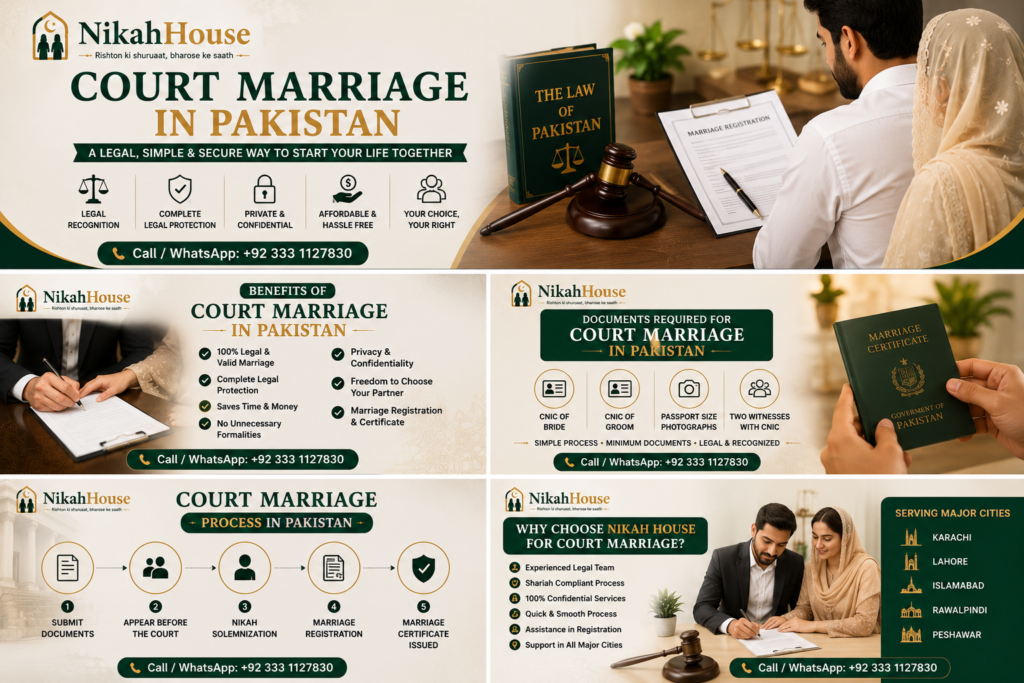
What Is Court Marriage in Pakistan?
The expression “Court Marriage” is widely used in Pakistan, but it can create a misleading impression that a judge must perform the marriage inside a courtroom.
For Muslim couples, that is ordinarily not what happens.
A Court Marriage generally involves a lawful Nikah undertaken by consenting parties with professional legal and documentary assistance, followed by proper completion and registration of the Nikah Nama.
Depending upon the circumstances, lawyers may also prepare supporting documentation recording the parties’ identities, ages and voluntary consent.
The important elements are the validity of the Nikah, free consent, legal eligibility, accurate documentation and lawful registration.
Is Court Marriage Legal in Pakistan?
Yes.
There is nothing unlawful about two legally eligible Muslim adults choosing to marry of their own free will and completing their Nikah and marriage registration without organising a traditional wedding ceremony.
Pakistani law requires Muslim marriages to be registered.
Section 5 of the Muslim Family Laws Ordinance, 1961 provides that every marriage solemnised under Muslim law must be registered under the Ordinance.
The law provides for licensed Nikah Registrars, and where another competent person solemnises the marriage, the marriage must be reported for registration according to the prescribed procedure.
Therefore, legal protection does not arise merely from calling the marriage a “Court Marriage”.
It arises from:
- lawful capacity;
- free consent;
- valid Nikah;
- accurate Nikah Nama;
- lawful registration; and
- proper supporting documentation.
Court Marriage vs Traditional Nikah vs Online Nikah
Issue | Court Marriage | Traditional Nikah | Online Nikah |
Muslim Nikah involved | Yes | Yes | Yes |
Couple usually together physically | Usually | Usually | Not necessarily |
Legal/documentary assistance | Usually extensive | Varies | Usually important |
Suitable where families oppose marriage | Frequently | Less common | Depends on circumstances |
Vakil may be used | Where appropriate | Yes | Frequently useful |
Witnesses | Required as applicable | Required | Required |
Haq Mehr | Must be addressed | Must be addressed | Must be addressed |
Nikah Nama | Yes | Yes | Yes |
Marriage Registration | Required | Required | Required |
Overseas suitability | Possible | Less convenient | Particularly suitable |
Courtroom ceremony required | No | No | No |
For couples living in different countries, our dedicated Online Nikah in Pakistan service may be more suitable.
Court Marriage Procedure in Pakistan
A properly managed Court Marriage should begin with legal verification rather than merely signing forms.
Step 1 — Initial Legal Consultation
We obtain information concerning:
- bride and groom;
- age;
- nationality;
- CNIC or passport;
- religion where legally relevant;
- current marital status;
- previous marriage;
- city of residence;
- proposed Haq Mehr; and
- any family or safety concerns.
Step 2 — Verify Legal Eligibility
The parties’ age, identity and marital status should be verified before the Nikah.
No professional marriage service should knowingly arrange a marriage that violates applicable child-marriage legislation or another mandatory law.
Step 3 — Verify Free Consent
Both parties must be entering the marriage voluntarily.
Where circumstances justify it, a written free-will affidavit or declaration may be prepared as supporting evidence of voluntary consent.
Such an affidavit is useful documentation but should not be confused with the Nikah itself.
Step 4 — Arrange the Nikah
The Nikah is solemnised according to the applicable Muslim-law requirements.
This ordinarily involves:
- Ijab-o-Qubul;
- witnesses;
- Haq Mehr;
- identification of the parties; and
- proper solemnisation.
Step 5 — Complete the Nikah Nama
Complete the prescribed Nikah Nama accurately.
Step 6 — Register the Marriage
The marriage is processed for registration through the competent Nikah Registrar/local-authority procedure.
Step 7 — Obtain Marriage Registration Documentation
After registration, the couple may obtain the computerised Marriage Registration Certificate, commonly referred to as a NADRA Marriage Certificate.
Court Marriage Process at a Glance
Stage | What Happens |
Consultation | Couple provides basic particulars |
Eligibility Check | Age, identity and marital status reviewed |
Consent | Free will confirmed |
Documents | CNIC/passport and supporting records checked |
Nikah | Marriage solemnised |
Haq Mehr | Agreed and recorded |
Nikah Nama | Prescribed form completed |
Registration | Marriage registered |
Certificate | Computerised certificate processed |
Foreign Use | Attestation/translation arranged if required |
Documents Required for Court Marriage in Pakistan
The precise requirements can differ according to the couple’s circumstances.
Person / Situation | Common Documents |
Pakistani Bride | CNIC and relevant identity particulars |
Pakistani Groom | CNIC and relevant identity particulars |
Overseas Pakistani | CNIC/NICOP and passport |
Foreign National | Passport and relevant immigration/identity documents |
Previously Divorced Person | Divorce documentation |
Widow / Widower | Death certificate of former spouse where applicable |
Witnesses | CNIC details |
Foreign Use | Additional attestation/translation documents where required |
Additional documents may be necessary where:
- one party lives abroad;
- one party is a foreign citizen;
- previous marital status requires verification;
- identity records contain discrepancies; or
- another legal issue must be resolved before marriage.
Court Marriage Age in Pakistan
Age requirements must be treated carefully because marriage-age legislation is territorial and has changed significantly.
For Nikah House’s principal operating cities, the current position is:
City / Territory | Minimum Age – Bride | Minimum Age – Groom |
Karachi / Sindh | 18 | 18 |
Lahore / Punjab | 18 | 18 |
Islamabad Capital Territory | 18 | 18 |
Nikah House should not perform or facilitate an underage marriage.
Current age requirements should always be checked according to the law applicable at the place and time of the intended marriage.
Court Marriage by Free Will
Free consent is fundamental to a valid marriage.
A man or woman should not be:
- forced;
- threatened;
- abducted;
- coerced;
- deceived about the proposed marriage; or
- compelled to sign marriage documents against their will.
This is particularly important in Court Marriage cases because family disagreement may exist.
Nikah House therefore verifies that both parties are voluntarily proceeding with the marriage.
Can an Adult Muslim Woman Marry Without Her Parents’ Consent?
This is one of the most frequently asked questions about Court Marriage in Pakistan.
The Supreme Court of Pakistan has held that a sui juris Muslim woman can contract a valid Nikah of her own free will and that her Wali’s consent is not necessary for the validity of the marriage.
Therefore, where a Muslim woman is legally competent to marry, absence of parental approval does not by itself make her marriage invalid.
This does not, however, mean that legal age requirements can be ignored.
The questions of:
legal age,
capacity,
free consent, and
Wali/parental approval
should be kept legally distinct.
Court Marriage With Parents’ Consent vs Without Parents’ Consent
Issue | With Family Consent | Without Family Consent |
Valid Nikah possible | Yes | Yes, subject to legal eligibility |
Free consent required | Yes | Yes |
Legal age required | Yes | Yes |
Nikah registration | Required | Required |
Documentation | Required | Particularly important |
Free-will affidavit | Usually unnecessary | May be advisable |
Safety concerns | Usually lower | May require legal assessment |
Parental permission decisive for sui juris Muslim woman? | Not an issue | Not required merely for validity |
Nikah House does not encourage unnecessary family conflict. However, where two legally competent adults have independently decided to marry, the legal procedure should be completed accurately and safely.
What Is a Free-Will Affidavit in Court Marriage?
A free-will affidavit is a supporting legal document commonly prepared in sensitive Court Marriage matters.
It may record that a party:
- is legally competent;
- has chosen the spouse voluntarily;
- has not been abducted;
- has not been coerced;
- is entering the marriage by free choice; and
- wishes to protect the factual record of consent.
Important Distinction
Document | Purpose |
Free-Will Affidavit | Evidence/declaration of voluntary choice |
Nikah Nama | Marriage contract and official Nikah record |
Marriage Registration | Statutory registration process |
Marriage Certificate | Computerised civil-registration document |
An affidavit does not itself create the marriage.
The Nikah must still be lawfully solemnised and registered.
Nikah Requirements in a Court Marriage
A Court Marriage does not remove the fundamental requirements of a Muslim Nikah.
The important elements ordinarily include:
- legally eligible bride and groom;
- free consent;
- Ijab-o-Qubul;
- witnesses as applicable;
- Haq Mehr;
- absence of a legal/Shariah impediment;
- Nikah solemnisation;
- Nikah Nama; and
- registration.
The Court Marriage process should therefore never be reduced to simply signing an affidavit in a lawyer’s office.
Haq Mehr in Court Marriage
Haq Mehr is an important right of the wife.
It should be discussed and entered accurately in the Nikah Nama.
The parties should understand:
- total Haq Mehr;
- prompt portion;
- deferred portion;
- property given as dower, if any;
- payment already made; and
- payment terms.
A hurried Court Marriage should never become an excuse for leaving important Nikah Nama columns blank.
Nikah Nama in Court Marriage
The Nikah Nama is one of the most important documents created during the marriage process.
It contains considerably more than the spouses’ names.
Important entries include:
- identities;
- addresses;
- age;
- marital status;
- witnesses;
- Vakil particulars where applicable;
- Haq Mehr;
- prompt/deferred dower;
- special conditions;
- delegated right of divorce where recorded;
- date and place of Nikah; and
- registration particulars.
Court Marriage vs Nikah Nama vs Marriage Certificate
Document / Process | Function |
Court Marriage | Common term for legally documented voluntary marriage process |
Nikah | Muslim marriage itself |
Free-Will Affidavit | Supporting evidence of consent where prepared |
Nikah Nama | Detailed contractual and official record of the Nikah |
Marriage Registration | Statutory recording of the marriage |
Marriage Registration Certificate | Computerised evidence of registered marriage |
Couples should avoid the common misconception that one document replaces all the others.
Marriage Registration After Court Marriage
Under section 5 of the Muslim Family Laws Ordinance, Muslim marriages must be registered.
A Court Marriage therefore should proceed beyond the ceremony and supporting affidavit.
Proper registration protects the documentary record for future purposes such as:
- CNIC marital-status updates;
- spouse visas;
- inheritance;
- family litigation;
- immigration;
- official benefits;
- passports;
- foreign residence; and
- proof of marital status.
Marriage Registration Certificate After Court Marriage
After the marriage has been registered, couples may require a computerised Marriage Registration Certificate.
The public often calls this a NADRA Marriage Certificate, although marriage registration is processed through the relevant local-government/Union Council civil-registration mechanism.
The certificate is frequently required for:
- immigration;
- spouse visa;
- embassy applications;
- family sponsorship;
- foreign residence;
- official marital-status evidence; and
- other administrative purposes.
Court Marriage for Previously Divorced Persons
A previously married person should disclose the earlier marriage before entering a new one.
Relevant documents may include:
- Divorce Registration Certificate;
- Talaq documentation;
- Khula decree;
- civil-registration record; or
- other proof of dissolution.
A person should not simply state that they are unmarried where a previous marriage remains legally relevant.
Court Marriage for Widows and Widowers
Where a former spouse has died, the death certificate or other appropriate documentation may be required.
The new Nikah must also respect any applicable Shariah requirement, including completion of Iddat where applicable.
Court Marriage Where the Groom Is Already Married
Where a Muslim man already has a subsisting marriage, additional requirements arise under the Muslim Family Laws Ordinance, 1961.
Section 6 regulates the contracting of another marriage during the subsistence of an existing marriage and provides for prior written permission of the Arbitration Council.
A second marriage should therefore not be processed as though the groom were unmarried.
Nikah House should review the existing marital status before proceeding.
Court Marriage for Foreign Nationals
A marriage between a Pakistani and foreign national requires additional documentary review.
Depending upon the circumstances, this may involve:
- foreign passport;
- visa/immigration status;
- marital-status documents;
- divorce record;
- death certificate of previous spouse;
- religious-status issues where applicable;
- translation;
- attestation; and
- embassy requirements.
The correct requirements depend upon the nationality and circumstances of the foreign party.
Court Marriage for Overseas Pakistanis
An overseas Pakistani may wish to marry while:
- visiting Pakistan;
- remaining outside Pakistan;
- marrying a person in Pakistan;
- marrying another Pakistani abroad; or
- marrying a foreign national.
Where both parties can attend in person, a conventional Court Marriage procedure may be appropriate.
Where one party cannot travel, Online Nikah or a properly documented Vakil arrangement may be more suitable.
Court Marriage vs Online Nikah for Overseas Couples
Situation | Court Marriage | Online Nikah |
Both parties physically in Pakistan | Excellent option | Usually unnecessary |
One party abroad | May require representation | Highly suitable |
Both parties abroad | Less practical | Often more practical |
Family opposition | Suitable | Depends on circumstances |
Immediate physical attendance possible | Yes | Not essential |
Vakil may be used | Yes | Frequently |
Registration required | Yes | Yes |
Marriage certificate available | Yes | Yes |
Our team can advise which process better fits the couple’s location and circumstances.
Is Court Marriage a Secret Marriage?
Court Marriage and secret marriage are not legally synonymous.
A couple may prefer confidentiality, but the marriage must still meet legal and Shariah requirements and be registered.
Nikah House handles sensitive matrimonial instructions with discretion.
However, confidentiality should never mean:
- false identity;
- false age;
- hiding an existing marriage where legally relevant;
- forged documents;
- avoiding mandatory registration; or
- violating child-marriage law.
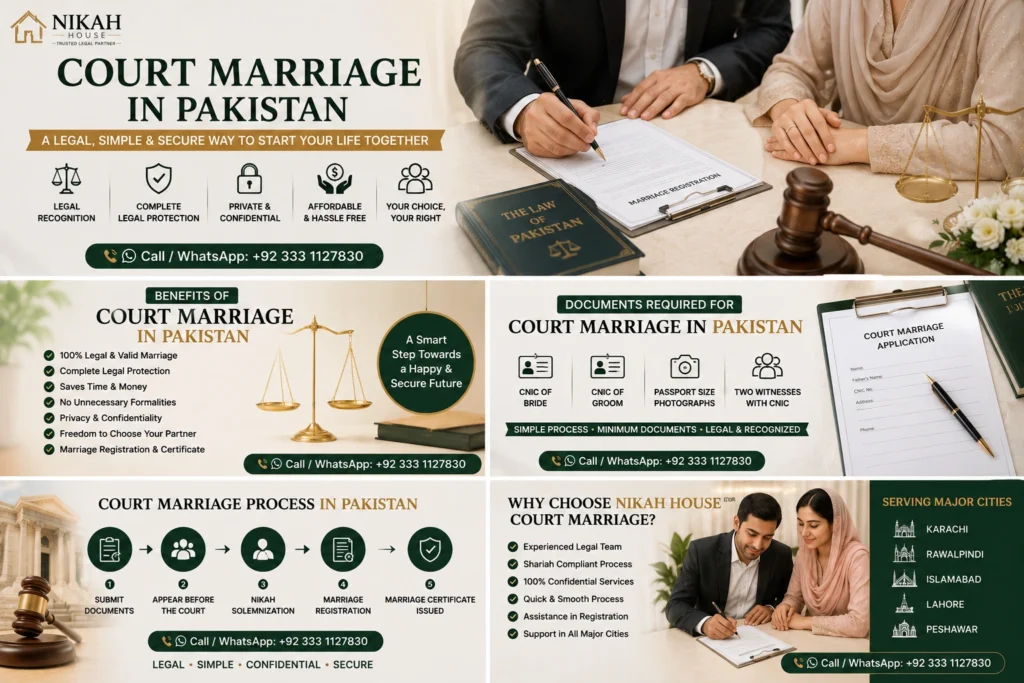
Court Marriage and Family Opposition
Family disagreement can create practical and sometimes serious legal problems.
Couples may face:
- emotional pressure;
- threats;
- allegations of abduction;
- attempts to separate the couple;
- confiscation of documents;
- restrictions on movement; or
- police complaints.
Where both individuals are legally competent adults acting freely, accurate documentation of:
- age;
- identity;
- consent; and
- marriage
becomes particularly important.
Seek professional legal advice immediately where genuine safety or criminal-law concerns arise.
Does Court Marriage Provide Police Protection?
A Court Marriage itself should not be advertised as an automatic “police protection certificate”.
Where an adult couple faces genuine threats or unlawful interference, appropriate legal remedies may be available, depending on the facts.
The correct remedy can depend upon:
- nature of threat;
- police complaint;
- criminal allegation;
- location;
- existing Court proceedings; and
- evidence of the marriage and consent.
Nikah House can arrange family-law documentation and, where necessary, refer the matter for appropriate legal protection proceedings.
Benefits of a Properly Documented Court Marriage
Benefit | Why It Matters |
Clear Consent Record | Helps establish voluntary marriage |
Verified Identity | Reduces future disputes |
Proper Nikah Nama | Records contractual terms |
Haq Mehr Documentation | Protects wife’s dower rights |
Registration | Creates formal civil record |
Marriage Certificate | Useful for official purposes |
Legal Advice | Identifies eligibility problems early |
Confidential Handling | Useful in sensitive family circumstances |
Overseas Documentation | Supports immigration/foreign use |
Accurate Record | Reduces future evidentiary disputes |
The benefit lies in correct documentation and lawful registration, not merely in using the words “Court Marriage”.
Court Marriage in Karachi
Nikah House assists consenting couples in Karachi with:
- Court Marriage;
- document verification;
- free-will documentation;
- Nikah Khawan;
- witnesses;
- Nikah Nama;
- marriage registration; and
- Marriage Registration Certificate assistance.
Sindh law currently treats persons below 18 years of age, male or female, as children for child-marriage purposes.
Court Marriage in Islamabad & Rawalpindi
Our team provides Court Marriage assistance to clients in Islamabad and Rawalpindi.
In Islamabad Capital Territory, current child-marriage legislation sets 18 years as the minimum age for both males and females.
Services include:
- eligibility review;
- Nikah;
- legal documentation;
- Nikah Nama;
- registration; and
- certificate assistance.
Court Marriage in Lahore
Nikah House provides Court Marriage services for Lahore couples requiring a properly documented Nikah and marriage registration.
Punjab enacted a new child-marriage framework in 2026, setting 18 years as the minimum marriage age for both males and females.
Our Lahore marriage services include:
- document review;
- Nikah arrangements;
- free-consent documentation where required;
- Nikah Nama;
- marriage registration; and
- certificate assistance.
Court Marriage Services by City
Service | Karachi | Islamabad/Rawalpindi | Lahore |
Court Marriage Consultation | ✓ | ✓ | ✓ |
Nikah Khawan | ✓ | ✓ | ✓ |
Free-Will Documentation | ✓ | ✓ | ✓ |
Nikah Nama | ✓ | ✓ | ✓ |
Marriage Registration | ✓ | ✓ | ✓ |
Marriage Certificate Assistance | ✓ | ✓ | ✓ |
Overseas Couples | ✓ | ✓ | ✓ |
Foreign National Cases | ✓ | ✓ | ✓ |
Why Choose Nikah House for Court Marriage?
Family-Law Experience
Court Marriage involves legal status and long-term matrimonial rights. It should not be handled merely as an event service.
Complete Marriage Process
We can assist from initial eligibility review through the Nikah, Nikah Nama and registration.
Legal & Shariah Consideration
The process is structured around both the applicable legal requirements and the fundamental requirements of Muslim marriage.
Confidentiality
Court Marriage cases may involve sensitive family circumstances and are handled discreetly.
Document Accuracy
Names, CNIC numbers, marital status and Haq Mehr are reviewed carefully before final documentation.
Multi-City Services
We assist couples in Karachi, Islamabad, Rawalpindi and Lahore.
Professional Legal Supervision
Nikah House is headed by Mohsin Ali Shah, Advocate, with legal practice dating from 1985 and experience in matrimonial and family-law documentation.
A legally informed Nikah Nama is particularly valuable where the marriage involves:
- substantial Haq Mehr;
- property;
- special conditions;
- previous marriage;
- overseas residence;
- foreign nationality;
- delegated divorce;
- or complex family circumstances.
Discuss Your Nikah Nama Before Signing
Legal Supervision of Nikah House
Professional Marriage Documentation Backed by Legal Experience
Nikah House is headed by Mohsin Ali Shah, Advocate, with legal practice dating from 1985 and extensive experience in matrimonial and family-law documentation.
Court Marriage clients benefit from legal review where the matter involves:
- family opposition;
- previous marriage;
- foreign nationality;
- overseas residence;
- disputed age;
- documentation problems;
- Power of Attorney; or
- complex Nikah Nama conditions.
Frequently Asked Questions About Court Marriage in Pakistan
Is Court Marriage legal in Pakistan?
Yes. Legally eligible consenting persons may enter a lawful marriage. For Muslim couples, the underlying marriage is a Nikah that must meet applicable Muslim-law requirements and be registered under Pakistani law.
Does a judge perform a court marriage?
Ordinarily, a Pakistani Muslim Court Marriage does not mean that a judge performs the Nikah in a courtroom. It commonly refers to a legally documented Nikah undertaken with professional legal assistance and proper registration.
What documents are required for Court Marriage?
Common documents include CNICs, photographs and documents relating to previous marital status where applicable. Foreign and overseas cases may require additional documentation.
What is the legal age for Court Marriage?
For Karachi/Sindh, Islamabad Capital Territory and Punjab/Lahore, current legislation sets 18 years as the minimum age for both males and females.
Can a Muslim woman marry without her parents' consent?
A sui juris Muslim woman can contract a valid Nikah of her own free will without requiring her Wali’s consent for the marriage to be valid.
Can parents cancel an adult daughter's marriage because they did not agree?
Parental disagreement alone does not invalidate the lawful free-will Nikah of a competent adult Muslim woman.
Is a free-will affidavit compulsory for every Court Marriage?
Not necessarily. It is commonly used as supporting evidence in sensitive free-will marriages, but the affidavit itself does not constitute the Nikah.
Is Court Marriage the same as Nikah?
For Muslim couples, Court Marriage ordinarily includes a Nikah. “Court Marriage” describes the practical/legal arrangement rather than a separate Islamic category of marriage.
Is Court Marriage the same as Online Nikah?
No. In Court Marriage, the parties are commonly physically present. Online Nikah is especially useful where one or both parties are in different locations.
Do witnesses attend Court Marriage?
The applicable witness requirements of the Muslim Nikah must be fulfilled.
Is Haq Mehr required?
Haq Mehr is an important part of the Muslim marriage contract and should be properly recorded.
Do we receive a Nikah Nama?
A properly solemnised and documented Muslim marriage should be recorded in the prescribed Nikah Nama.
Is Court Marriage registered?
Muslim marriages must be registered in accordance with Pakistani law.
Can we obtain a NADRA Marriage Certificate?
After proper marriage registration, a computerised Marriage Registration Certificate may be obtained through the applicable civil-registration process.
Can a divorced woman perform Court Marriage?
Yes, provided her previous marriage has legally ended and all applicable legal and Shariah requirements, including Iddat where relevant, have been completed.
Can a widow perform Court Marriage?
Yes, after satisfaction of the applicable legal and Shariah requirements.
Can an already-married Muslim man perform another Court Marriage?
A subsisting marriage raises additional statutory requirements under section 6 of the Muslim Family Laws Ordinance and must be reviewed before proceeding.
Can a Pakistani marry a foreign national through Court Marriage?
Potentially yes, subject to the legal capacity, identity, marital status and additional documentary requirements applicable to the foreign national.
Can Court Marriage be done in one day?
Some straightforward cases may be solemnised and documented promptly where all requirements are already satisfied. Registration and certificate processing may require additional time.
Can Court Marriage be confidential?
Yes, the professional service can be handled discreetly, although legal documentation, witnesses and registration requirements cannot be avoided merely for secrecy.
Can an overseas Pakistani arrange Court Marriage?
Yes. If the parties are physically present, conventional Court Marriage can be arranged. Where one party remains abroad, Online Nikah or representation through a Vakil may be more suitable.
Is Court Marriage recognised for a spouse visa?
A properly registered Pakistani marriage can be used as marriage evidence, but each foreign immigration authority determines its own documentary requirements.
Do marriage documents require MOFA attestation?
For foreign use, MOFA or embassy attestation may be required depending on the receiving country and purpose.
Can Nikah House arrange a Nikah Khawan?
Yes. Nikah Khawan/Qazi services form part of our marriage services.
How do we start the Court Marriage procedure?
Contact Nikah House with the bride’s and groom’s ages, CNIC status, marital status, city, and proposed marriage date so we can review the documents and legal requirements.
Arrange Your Court Marriage With Nikah House
A Court Marriage should be lawful, voluntary, properly documented and registered.
If you and your prospective spouse have decided to marry, our team can review your eligibility, prepare the necessary documentation and arrange the Nikah and registration procedure.